Between 1895 and 1917, a seven-volume catalogue of the numismatic collection of Prince Ernest of Windisch-Graetz1 was published. The fifth volume, devoted to Greek coins, was written by Dr Josef Scholz (see Scholz 1899). On pp. 112–113, two remarkable coins from the Kelenderis mint are listed under catalogue numbers 1828 and 1829. The first is a stater measuring 21 mm in diameter and weighing 10.72 g, described as follows:
Av. Nackter Reiter r. eine Peitsche haltend. Rev. Kniende Ziege r. sich umwended.
Since both designs face right, the coin may belong to one of Types 3.7–3.17 (see Kelenderis, Group 3). Its weight of 10.72 g, however, indicates that Types 3.15–3.17 can be excluded (see the weight analysis of the Kelenderis staters). The form of the city ethnic on the reverse is noteworthy and is printed in the catalogue as follows:
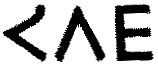
The catalogue contains no photograph or drawing of the coin, so the accuracy of this reading cannot be assessed. There are two possibilities. The legend may be a distorted form of KΛE, in which the letter K was only partially struck and was therefore rendered by Dr Scholz in the form shown above. If so, the coin would represent a new variant. More likely, however, the actual form was KEΛE, with the letter K outside the flan and only a small, distorted portion of the first E visible. The abbreviated city ethnic KEΛE occurs on Types 3.8a, 3.9a, 3.16a, and 3.17a–b. The coin’s weight rules out Types 3.15–3.17, leaving 3.8a and 3.9a as the remaining possibilities. Type 3.8a has an additional letter Σ beneath the city ethnic, which would probably not have been overlooked. Type 3.9a therefore appears to be the most likely identification.
The second coin is an obol measuring 10 mm in diameter and weighing 0.85 g; it is assigned the rarity grade RR (very rare). It is described as follows:
Av. Bock, sich niederlegend KEΛ. Rev. Vordertheil eines Greifes r. Λ ?
Again, no illustration of the coin is available. The legend KEΛ confirms that it is indeed a Kelenderis coin. Dr Scholz apparently mistook Pegasus for a griffin, which would identify the coin as one of the variants 5.4b–e. If the side depicting Pegasus did indeed bear the letter Λ, the coin would represent a new variant of Type 5.4. The letter Λ is followed by a question mark in the description, however, so the supposed letter may merely represent a trace of a die crack. In any case, the weight of 0.85 g corresponds to this type (see the weight analysis of the Kelenderis obols).
1 Ernest Ferdinand Weriand, Prince of Windisch-Graetz (German: Ernst Ferdinand Weriand Prinz zu Windisch-Grätz; 27 September 1827 – 22 November 1918), was a Czech-Austrian nobleman, collector of art and coins, archaeologist, and politician.
13 April 2024 – 6 September 2026