The reverses of all early Holmoi coins, classified in this catalogue as Group 1, depict ship sterns. The nearest mint to use the same reverse motif was Phaselis in Lycia. Phaselis coins probably inspired the reverses of these Holmoi issues, just as their obverse types were inspired by those of Kelenderis (a dismounting rider or the forepart of Pegasos). In later Holmoi issues (Group 2), however, the ship motif is abandoned; the reverse instead depicts Apollo or, more rarely, a bearded divine head (Type 2.3), possibly representing Poseidon, Zeus, or Kronos.
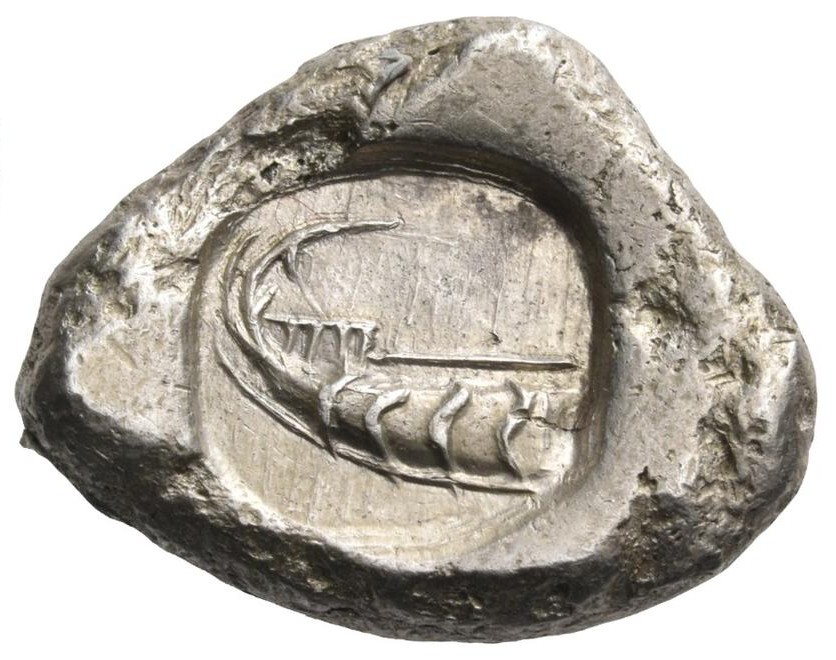
The ship stern depicted on Type 1.1 coins, which represent the earliest Holmoi issues, has a long aphlaston, a railing at the end of the stern, a prominent keel, and four vertical elements on the ship’s side (Figure 1). The first element, which is arched, probably represents a hull reinforcement. A similar feature appears on the Phaselis stater in Figure 2. The other three vertical elements, however, are unusual. They are not arched but S-shaped, apparently following the curve of the ship’s side from the gunwale to the keel. They therefore cannot represent oars. Nor are they likely to be external wooden ribs reinforcing the hull, since such a construction would significantly impair the ship’s hydrodynamic properties. They may instead be heavy ropes intended to protect the ship’s sides in shallow coastal waters or in the harbour, or they may be purely decorative features.
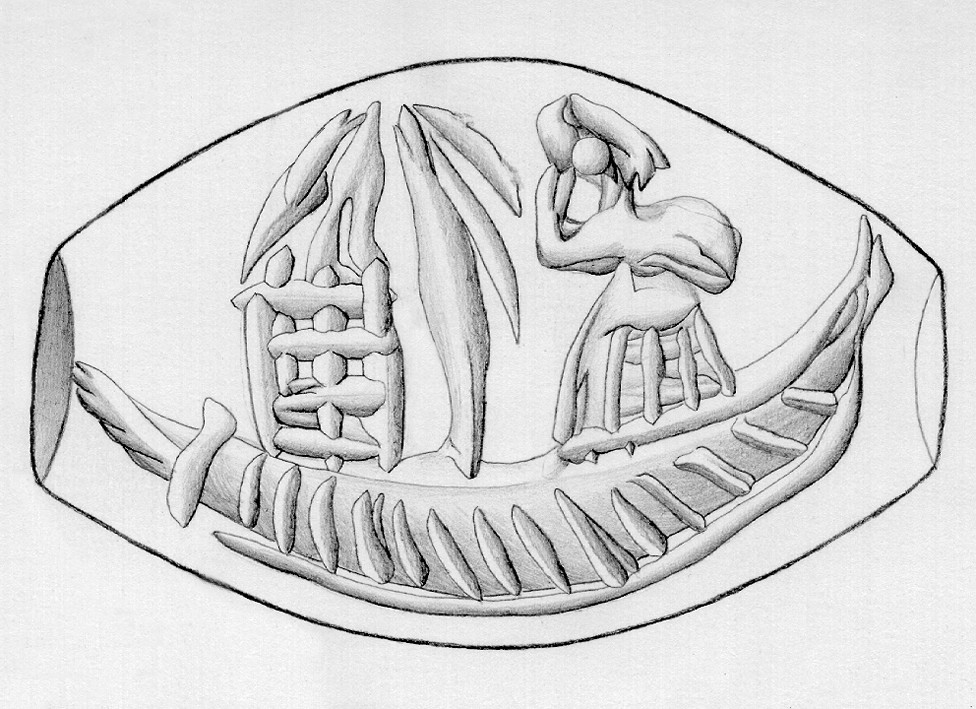
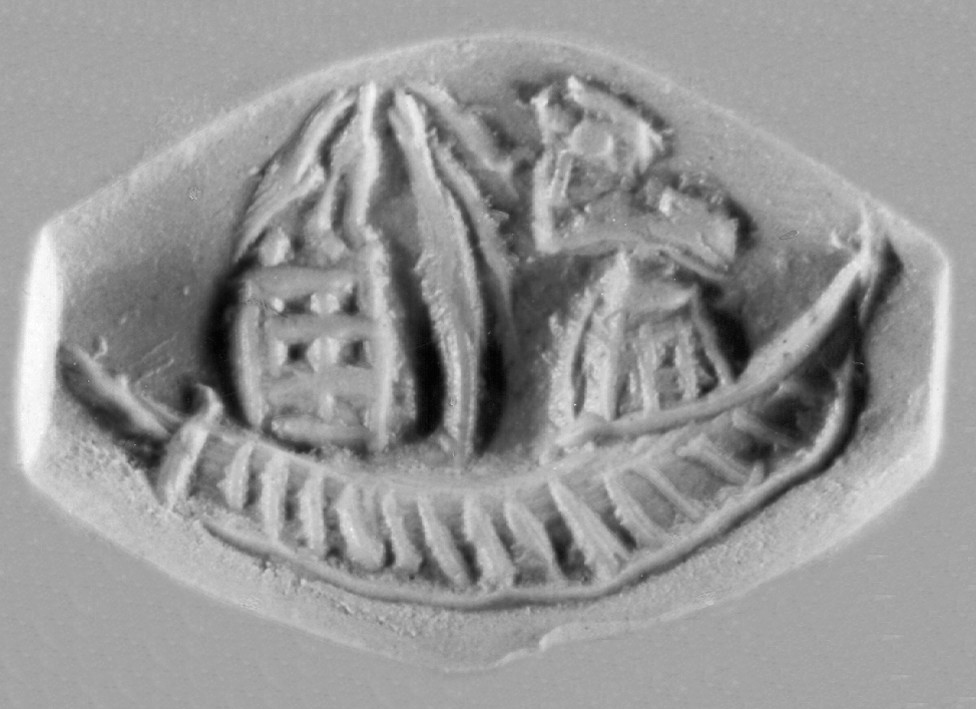
A Late Minoan seal from Makrygialos on the south-east coast of Crete (CMS V Suppl. 1A, Cat. No. 055; Wedde 2000, Cat. No. 907) depicts a ship with similar vertical strokes on its side (Figure 3). The scene shows a cult ship, with a priestess raising her right hand in the typical Minoan gesture of adoration on the right, a sacred palm tree in the centre, and an ikrion (a cabin or shrine) on the left.1 According to Wedde 2000, pp. 38 and 339, the oblique line at the left extremity represents a steering oar, while the remaining fourteen short strokes depict ribs. However, external ribs would be hydrodynamically impractical, as noted above. The strokes may instead represent protective or decorative features similar to those on the Holmoi coins.
 |
 |
|
Figure 1. Holmoi. Stater, Type 1.1a. |
Figure 2. Lycia, Phaselis. Stater, c. 250–221/0 BC. |
 |
 |
|
Figure 3. Seal from Makrygialos (Crete), Late Minoan IB period (1675–1460 BC). Drawing and photograph of the seal impression. Images courtesy of CMS Heidelberg. |
|
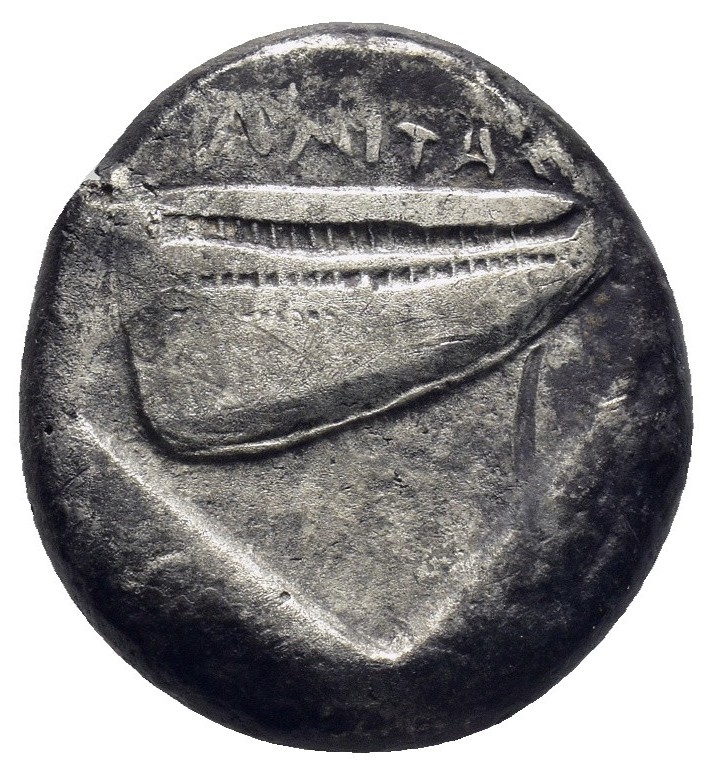
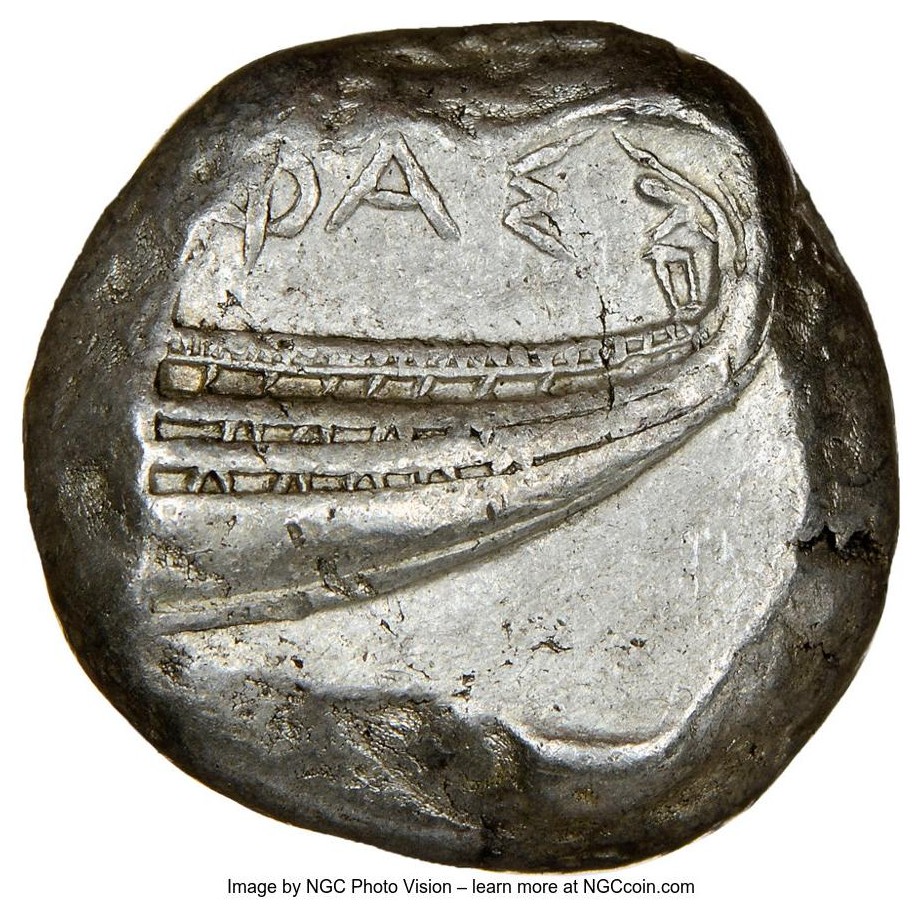
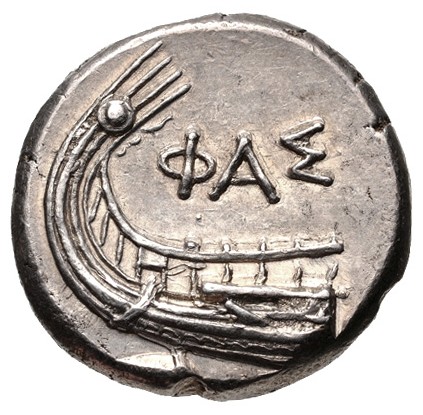
Type 1.2 staters probably depict a trireme (trieres in ancient Greek), i.e. a ship with three tiers of oars (Figure 4).2 The upper two rows of oar ports are clearly shown; the lowest row is indicated by a row of dots. The oar ports would have been largest in the upper row, smaller in the middle row, and smallest in the lowest row. A similar but more elaborate depiction of a trireme appears on the Phaselis stater in Figure 5.
 |
 |
|
Figure 4. Holmoi. Stater, Type 1.2. |
Figure 5. Lycia, Phaselis. Stater, c. 500–440 BC. |
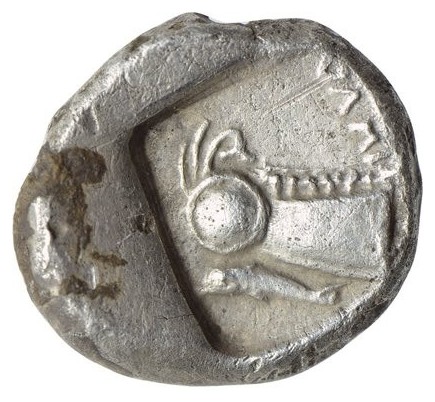
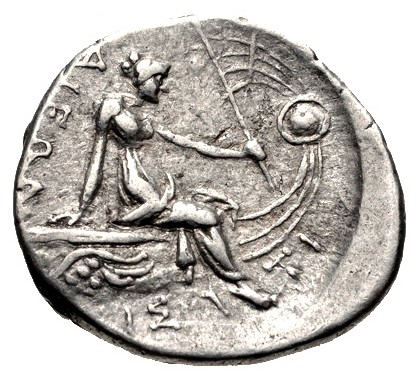
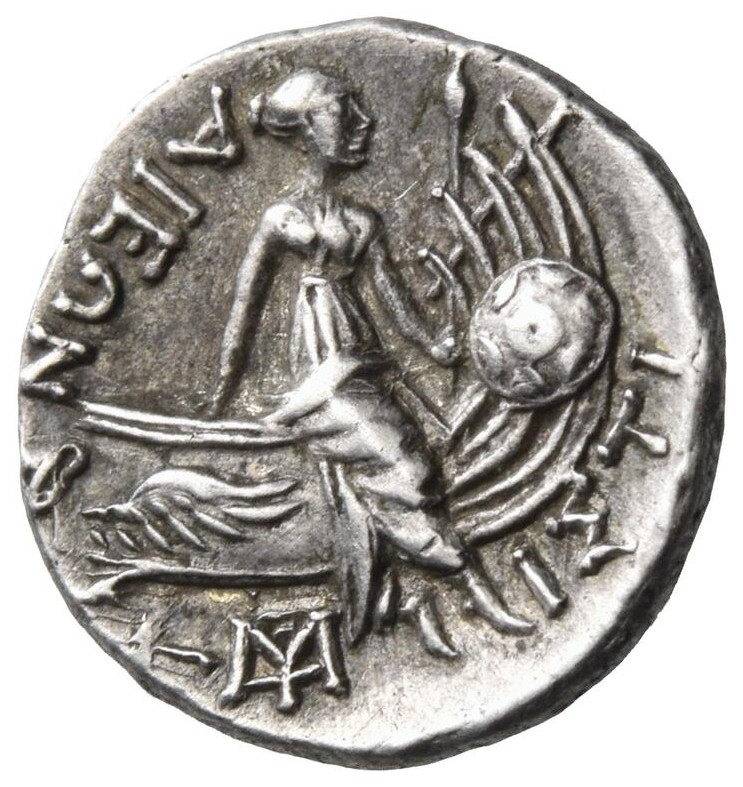
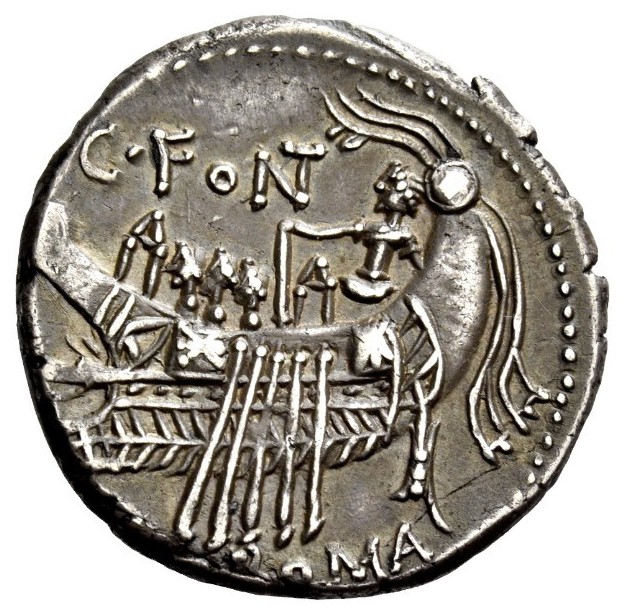
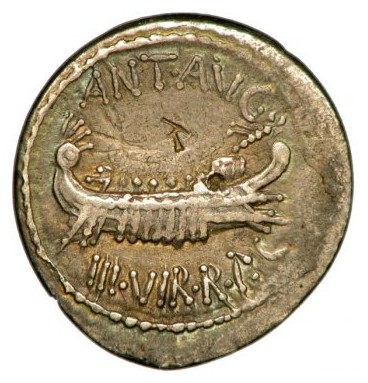
An unusual feature of the third staters of Type 1.3 (Figure 6) is a large shield, which may bear the image of a protective deity or symbol. A dolphin also appears below the ship. Both the size of the shield relative to the ship and its low position are remarkable. Smaller shields placed on the aphlaston, however, appear on many coins as late as the Roman period (Figures 7–11). A ship stern with a shield on the aphlaston also appears in the background of a marble relief of Paris and Oinone in the Palazzo Spada in Rome. Inspired by Hellenistic art, the relief dates to the 2nd century AD.3 Such a shield could also have served a purely decorative or propagandistic purpose, as shown by the Macedonian shield on the Histiaia tetrobol in Figure 9.
 |
 |
|
Figure 6. Holmoi. Third Stater, Type 1.3. |
Figure 7. Lycia, Phaselis. Stater, 4th century BC. |
 |
 |
|
Figure 8. Euboia, Histiaia. Tetrobol, 3rd–2nd centuries BC. |
Figure 9. Euboia, Histiaia. Tetrobol, 3rd–2nd centuries BC. |
 |
 |
|
Figure 10. Roman Republic, C. Fonteius, Rome. Denarius, 114–113 BC. |
Figure 11. Roman Republic, Marcus Antonius, travelling military mint. Denarius, 32–31 BC. |
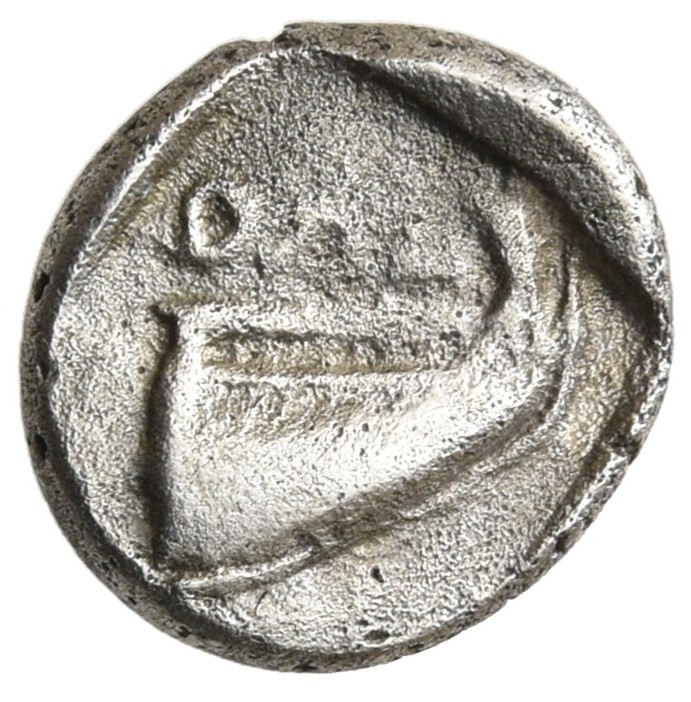
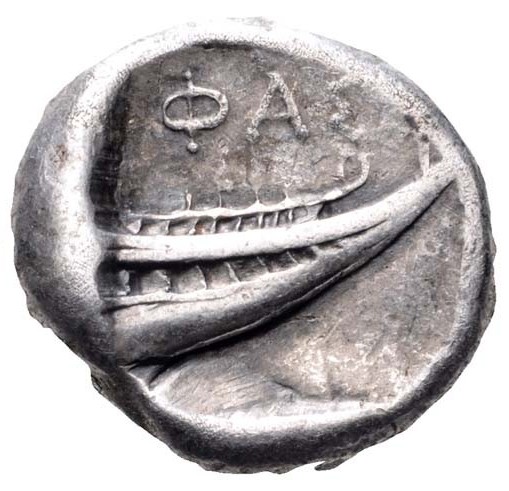
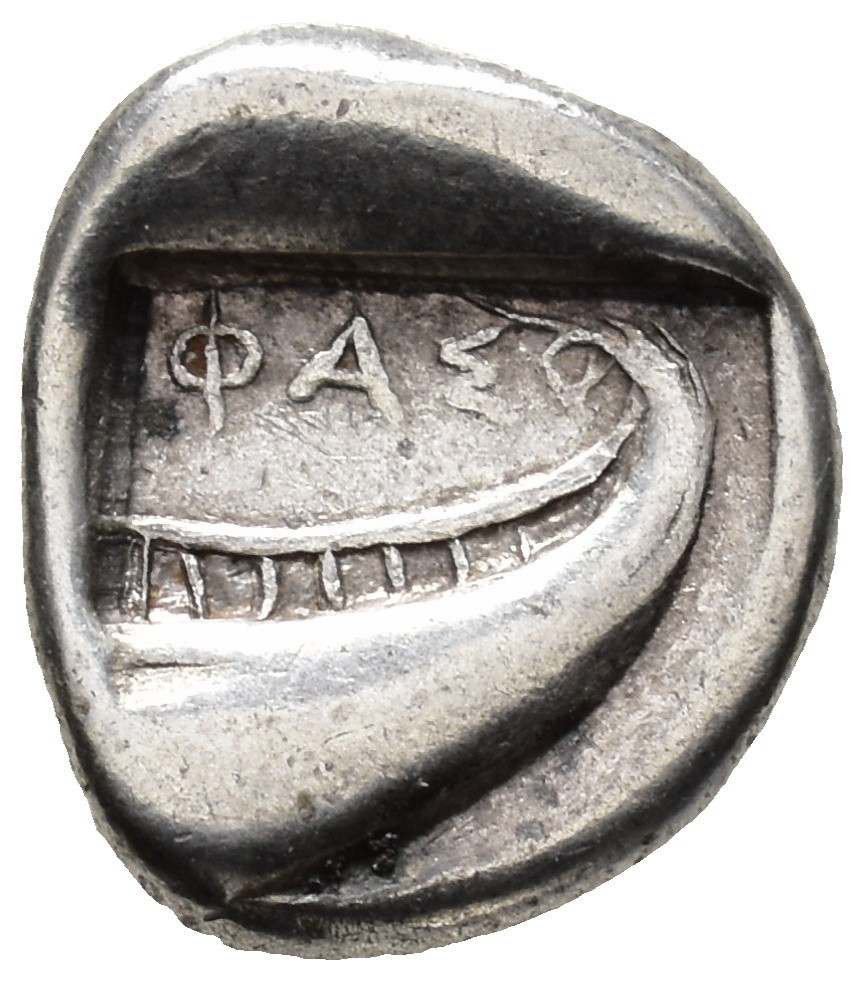
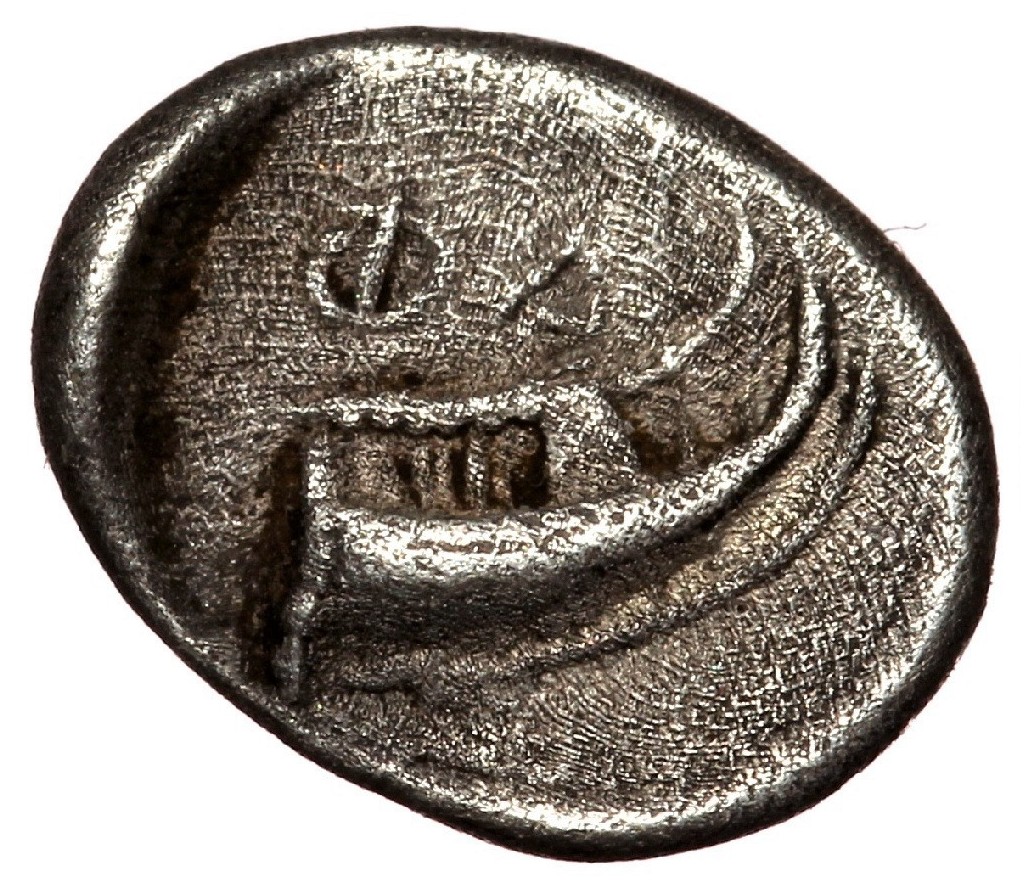
The obol of Type 1.4 (Figure 12) depicts the stern of a smaller ship, probably with two rows of oar ports, although only one row may be intended. Comparable depictions of small ships appear on Phaselis third staters and obols (Figures 13–15).
 |
 |
|
Figure 12. Holmoi. Obol, Type 1.4. |
Figure 13. Lycia, Phaselis. Third Stater, c. 500–440 BC. |
 |
 |
|
Figure 14. Lycia, Phaselis. Third Stater, c. 500–440 BC. |
Figure 15. Lycia, Phaselis. Obol, c. 500–440 BC. |
| Credits: | |
| Figure 1: | Nomos AG, Auction 19 (17 November 2019), Lot 175 (acsearch.info URL). |
| Figure 2: | Nomos AG, Auction 25 (20 November 2022), Lot 230 (acsearch.info URL). |
| Figure 3: | Images courtesy of CMS Heidelberg (Heidelberg University, Center for Ancient Studies). |
| Figure 4: | P. Veselý. |
| Figure 5: | Heritage Auctions, Inc., Auction 231937 (12 September 2019), Lot 62102 (acsearch.info URL). |
| Figure 6: | Numismatik Naumann, Auction 39 (3 January 2016), Lot 415 (acsearch.info URL). |
| Figure 7: | Classical Numismatic Group, Electronic Auction 368 (10 February 2016), Lot 96 (acsearch.info URL). |
| Figure 8: | Classical Numismatic Group, Electronic Auction 232 (28 April 2010), Lot 88 (acsearch.info URL). |
| Figure 9: | Nomos AG, Auction 20 (10 July 2020), Lot 143 (acsearch.info URL). |
| Figure 10: | Numismatica Ars Classica NAC AG, Auction 97 (12 December 2016), Lot 9 (acsearch.info URL). |
| Figure 11: | CGB Numismatics Paris, MONNAIES 45 (14 October 2010), Lot 260 (acsearch.info URL). |
| Figure 12: | P. Veselý. |
| Figure 13: | Roma Numismatics Limited, E-Sale 21 (31 October 2015), Lot 364 (acsearch.info URL). |
| Figure 14: | Numisart GmbH, Auction 5 (16 June 2024), Lot 84 (acsearch.info URL). |
| Figure 15: | DEMOS Auctions, Auction 1 (17 April 2021), Lot 94 (acsearch.info URL). |
1 Wedde 2000, pp. 185–9 and 339; Davaras 2004, p. 4.
2 For ancient triremes, see Casson 1995, pp. 77–96.
3 For an analysis and photographs of the Spada reliefs, see Kampen 1979. For a description and detailed photograph of the ship’s stern on the relief depicting Paris and Oinone, see Casson 1995, p. 118, including note 74 and Figure 114.
25 March 2025 – 6 September 2025