A distinct group of Kelenderis coins features an isolated letter heta in its archaic boxed form on the reverse. These include Type 2.5 staters, Type 4.3 third staters, and Type 5.5 obols. With the exception of variant 2.5a, these coins are also linked by the symbol of a round shield on the obverse. These denominations were evidently minted as part of the same series during the same period. The occurrence of the boxed form of the letter heta on these coins indicates that this archaic letterform was still employed in Cilicia in the late 5th or early 4th century BC. However, since it appears as an isolated symbol rather than as part of an inscription, its phonetic value and precise function are uncertain.
The archaic letter heta also appears on coins of the Phanes series, traditionally attributed to Ephesus, and on coins from Himera, Haliartos and Argos. Unlike at Kelenderis, however, its function on these coins can generally be identified or inferred. On coins of the Phanes series, it represents a vowel in the inscription; on coins of Himera and Haliartos, it represents the aspirate associated with the name of the respective polis; and on coins of Argos, it probably denotes the denomination.
| Sicily, Himera: | |
| • | AR litra, c. 470–450 BC (Figure 1). Obv.: Bearded male head wearing a taenia. Rev.: Corinthian helmet; surrounding legend H-I-M – E-RA (retrograde, with the letter H in its archaic form). BMC 2, p. 81, 46.1 |
| Boiotia, Haliartos:2 | |
| • | AR drachm, c. 525–480 BC (Figure 2). Obv.: Boeotian shield, with an archaic heta in each of the two side openings. Rev.: incuse square with a clockwise mill-sail pattern. BMC 8, p. 48, 1–2.3 |
| • | AR stater, drachm, hemidrachm and obol, c. 475–450 BC (Figure 3). Obv.: Boeotian shield (on some staters, with the rim divided into eight segments). Rev.: square incuse with a clockwise mill-sail pattern; in the centre, archaic heta. BMC 8, p. 48, 3–6 (staters) and 7–8 (drachms), p. 49, 9 (hemidrachm) and 10 (obol).4 |
| Argolis, Argos:5 | |
| • | AR hemiobol, 5th century BC (Figure 4). Obv.: archaic heta. Rev.: large A in an incuse square (on some coins, additional symbols). BMC 10, p. 138, 27–28. |
| • | AR hemiobol, 4th–3rd century BC (Figure 5). Obv.: forepart or head of a wolf facing left. Rev.: large A in an incuse square; legend; archaic heta and other symbols. BMC 10, p. 141, 64. |
| • | AR hemiobol, 4th–3rd century BC. Obv.: wolf facing left; above, archaic heta. Rev.: crested Corinthian helmet facing left. BMC 10, p. 142, 84–85. |
| • | AE dichalka, c. late 2nd century–early 80s BC (Figure 6). Various types (head of Apollo, Hera or a wolf on the obverse), with the archaic letter heta as a secondary symbol on the reverse. BMC 10, p. 143, 97–98, p. 146, 31–33, p. 147, 138–139 and 142–145.6 |
| Ionia, Phanes (traditionally attributed to Ephesos): | |
| • | EL stater, c. 625–600 BC (Figure 7). Obv.: Grazing stag; above, retrograde inscription ΦΑΝΟΣ ΕΜΙ ΣΗΜΑ and its variants, with an elongated boxed form of the archaic letter heta. Rev.: Three incuse punches, the central one rectangular and the two flanking ones square. Fischer-Bossert (2020), pp. 443–445; BMC 14, p. 47, 1. |
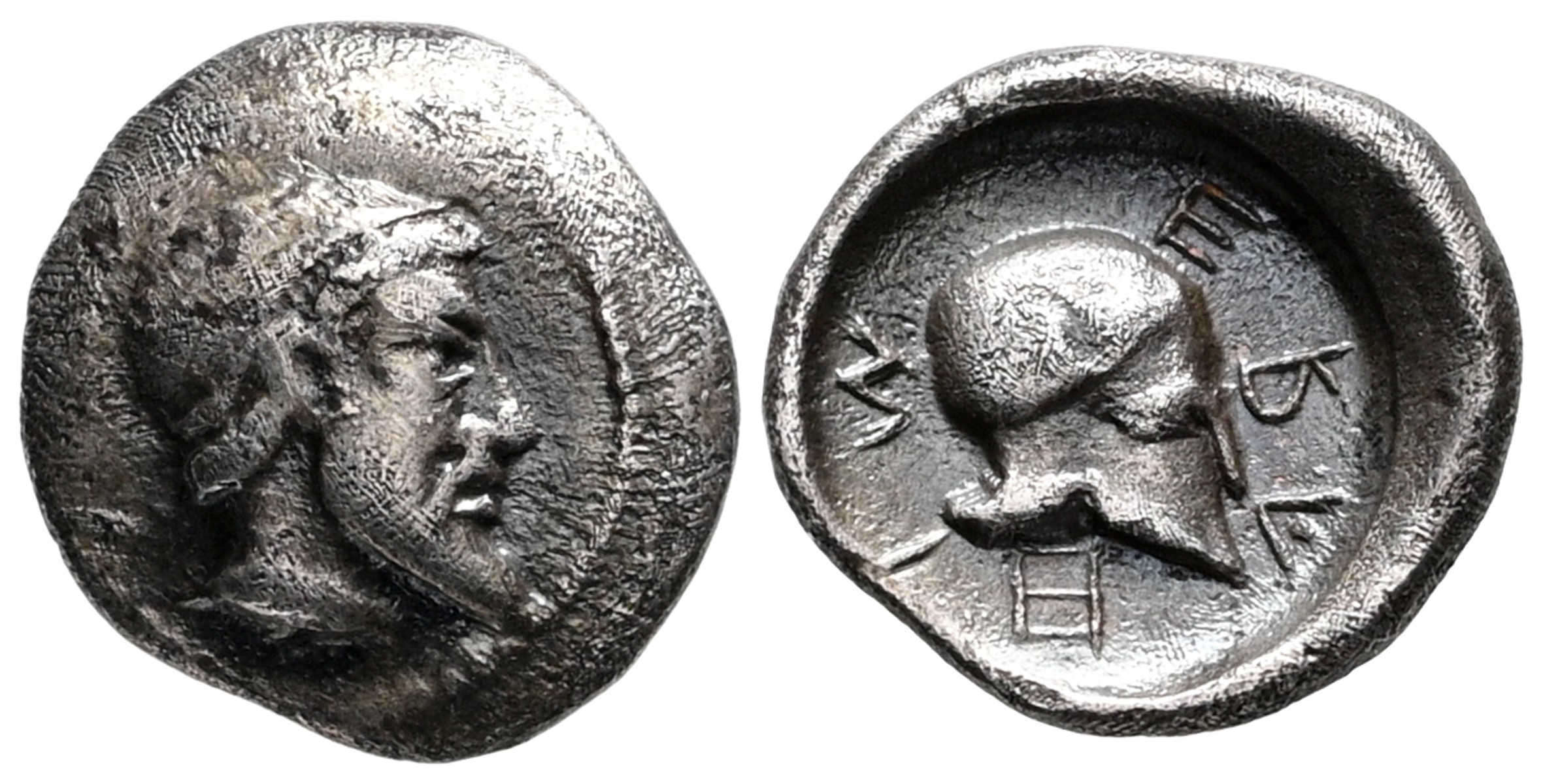
| Figure 1. Himera, AR litra, 470–450 BC. |
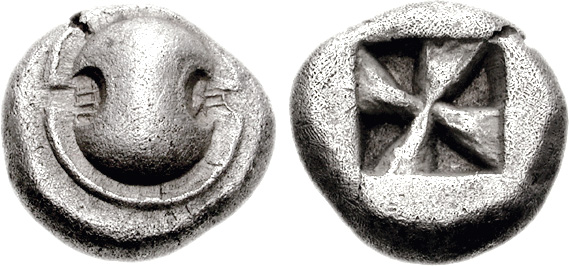
| Figure 2. Haliartos, AR drachm, c. 525–480 BC. |
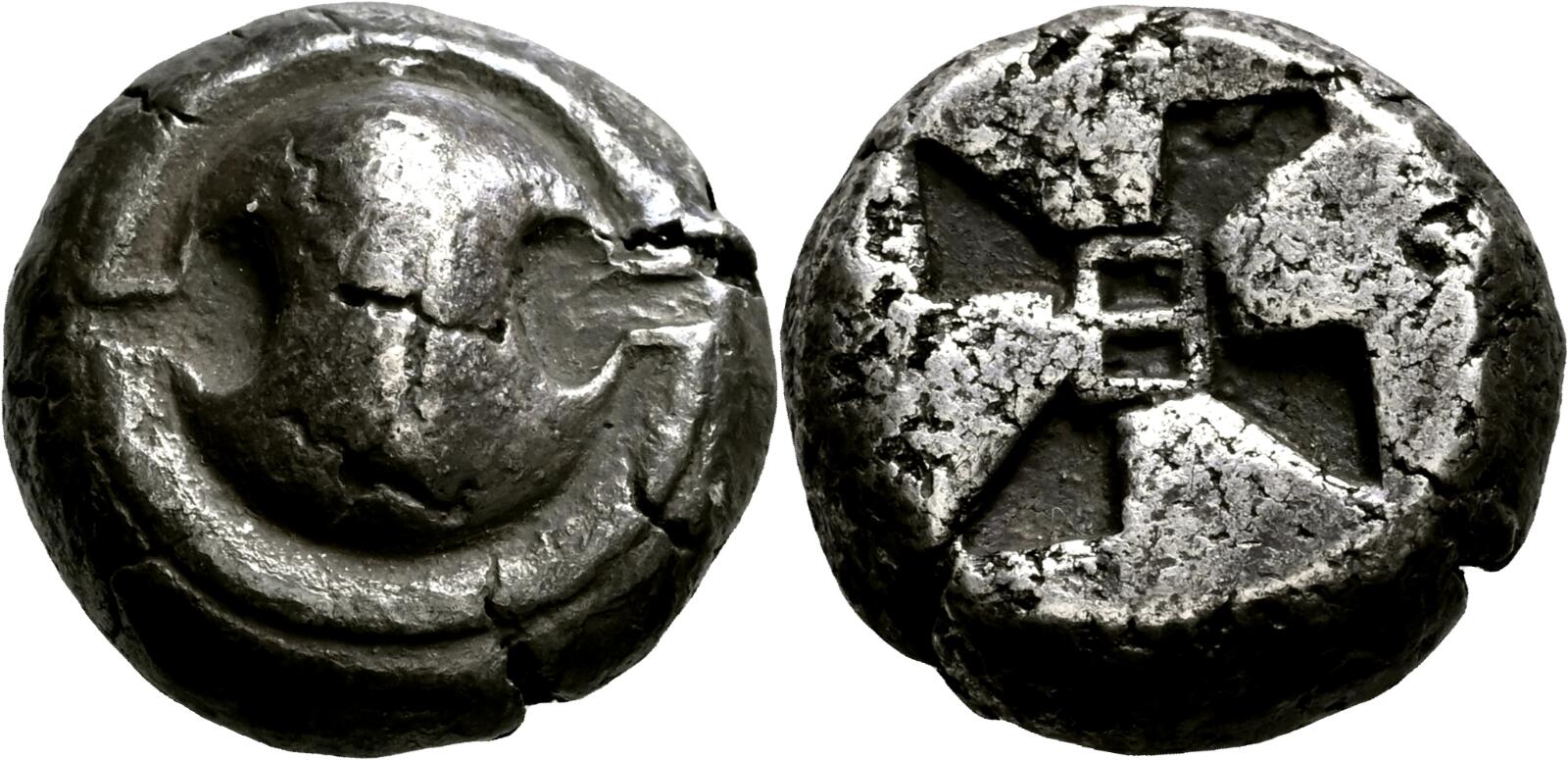
| Figure 3. Haliartos, AR stater, c. 475–450 BC. |
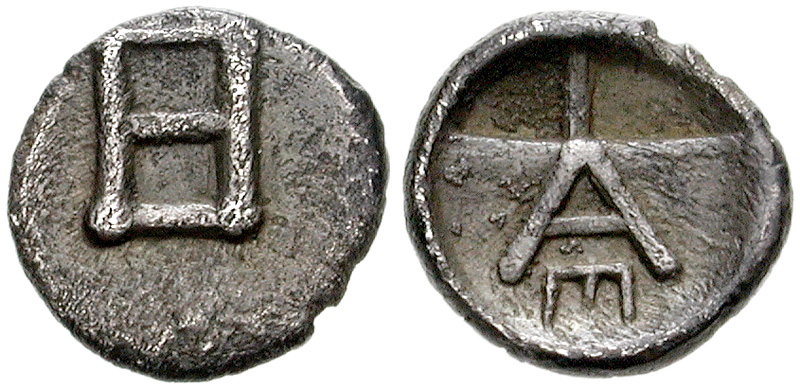
| Figure 4. Argos, AR hemiobol, 5th century BC. |
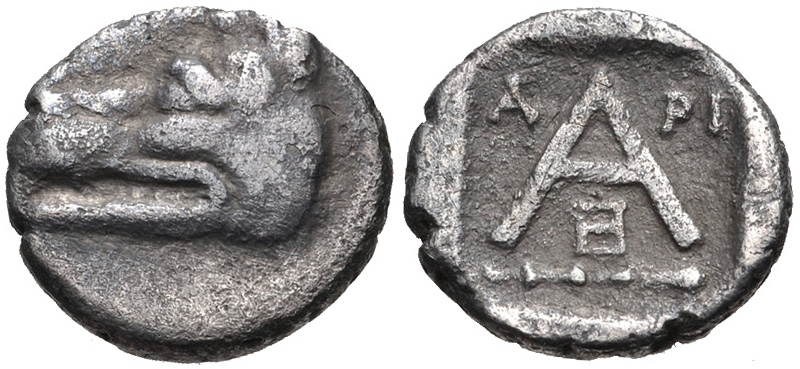
| Figure 5. Argos, AR hemiobol, 4th–3rd century BC. |
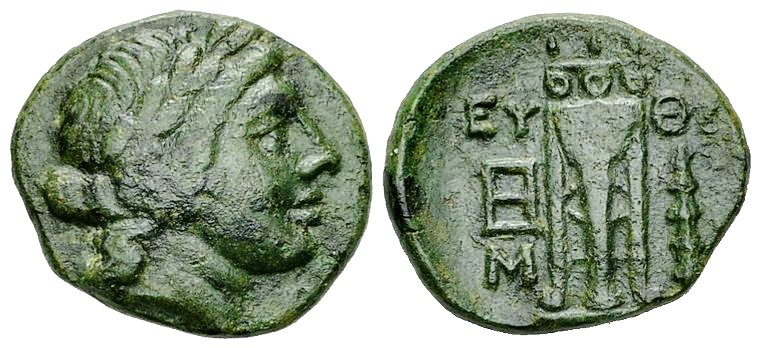
| Figure 6. Argos, AE dichalkon, late 2nd century to early 80s BC. |
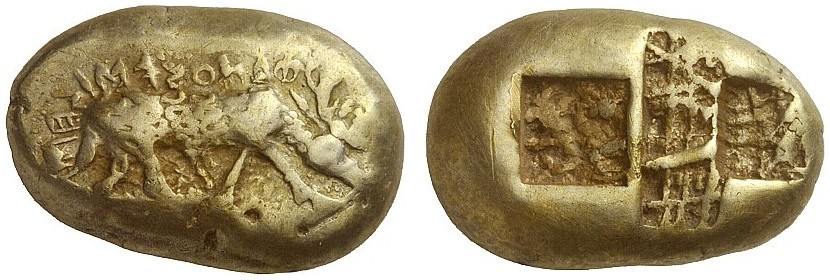
| Figure 7. Ionia, Phanes, EL stater, c. 625–600 BC. |
| Credits: | |
| Figure 1: | Leu Numismatik, Web Auction 42 (27 June 2026), Lot 84 (acsearch.info URL). |
| Figure 2: | Classical Numismatic Group, Mail Bid Sale 72 (14 June 2006), Lot 573 (acsearch.info URL). |
| Figure 3: | Dr. Busso Peus Nachfolger, Auction 439 (4 November 2024), Lot 233 (acsearch.info URL). |
| Figure 4: | Classical Numismatic Group, Electronic Auction 160 (14 March 2007), Lot 48 (acsearch.info URL). |
| Figure 5: | Classical Numismatic Group, Electronic Auction 261 (3 August 2011), Lot 71 (acsearch.info URL). |
| Figure 6: | Auctiones GmbH, eAuction 47 (24 April 2016), Lot 21 (acsearch.info URL). |
| Figure 7: | Numismatik Lanz München, Auction 158 (5 June 2014), Lot 252 (acsearch.info URL). |
1 The British Museum (London), museum number 1841,0726.189 (BMC 2, p. 81, 46).
2 Fossey 2019 (pp. 42–45 and Fig. 8) discusses at least eight distinct forms of the archaic letter heta on early Boeotian coins traditionally attributed to Haliartos. He questions this attribution and suggests that the different letterforms may have been used to distinguish coins issued by different Boeotian cities.
3 The British Museum (London), museum numbers 1844,1008.144 (BMC 8, p. 48, 1), EH,p389.1.Theb (BMC 8, p. 48, 2).
4 The British Museum (London), museum numbers RPK,p40B.3.The (BMC 8, p. 48, 4), EH,p389.3.Theb (BMC 8, p. 48, 5), EH,p389.2.Theb (BMC 8, p. 48, 6), 1841,B.1368 (BMC 8, p. 48, 7), RPK,p41D.2.Theb (BMC 8, p. 49, 9), RPK,p42F.7.Theb (BMC 8, p. 49, 10).
5 On early Argive silver coins, the archaic letter heta appears to have served as a denomination mark for the hemiobol, just as the letter tau (Τ) was used for the tetartemorion (for example, Numismatica Ars Classica NAC AG, Auction 123 (9 May 2021), Lot 546 (acsearch.info URL)). However, Head (1911, p. 437) interpreted the heta as the initial letter of Hera or the Heraian Games, citing its occurrence on later bronze coins and parallels from the Argive Heraion, including a stamped roof tile and a pottery inscription referring to Hera (Waldstein 1902, Vol. 1, p. 224). The continued use of the letter on later bronze coins suggests that its function may not have been exclusively denominational.
6 The British Museum (London), museum numbers 1866,1201.3286 (BMC 10, p. 147, 138), 1849,0119.11 (BMC 10, p. 147, 139), 1866,1201.3295 (BMC 10, p. 147, 143), GC10 (BMC 10, p. 147, 144), TC,p142.10.Arg (BMC 10, p. 147, 145).
25 October 2026 – 28 October 2026