Hybrid Staters
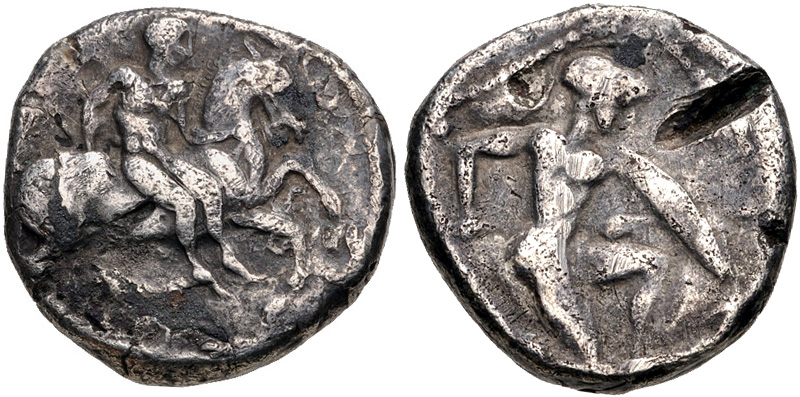
| Type HS.1 | |
| Denomination: | AR Stater |
| Obverse: | Youthful nude rider, holding reins in left hand and whip in right, dismounting from horse rearing to right on dotted exergual line. | |
| Reverse: | Naked hoplite kneeling right, wearing Corinthian helmet, holding spear (?) in right hand, shield in left. | |
| Metrics: | 10.42 g, 20 mm, 4h (the cited specimen) | |
| References: | Classical Numismatic Group, Electronic Auction 293 (19 December 2012), Lot 115 (acsearch.info URL) | |
| Credit: | Classical Numismatic Group (see the reference above) | |
| Remarks: | (1) | The coin is corroded, so many details cannot be discerned. The obverse corresponds to those of Group 3. The reverse corresponds to the Tarsos staters with the Great King on horseback on the obverse (for this coin type, see for example SNG France 2, 211, 212, 215, 216 and 217; for the iconographic analysis of the horseman on Tarsos coins, see Tahberer 2021, pp. 7–10). |
| (2) | The coin is a contemporary imitation because it has several features that distinguish it from the regular coinage. These include, in particular, the atypical position of the horse’s right foreleg, which is higher than the left, and the fragmentary, crude rendering of the hoplite’s spear on the reverse. On regular Kelenderis coins, the foreleg farther from the viewer is always higher than the nearer one. It may seem odd that coins from two different mints were used as models for the obverse and reverse, but a similar combination occurs on the hybrid coin from Nagidos, Type HS.1, which is undoubtedly a contemporary imitation. A modern origin is unlikely given the coin’s poor condition and consequent lack of attractiveness. | |
| (3) | The coin shares the obverse die with Type XS.4 listed below, which is also a contemporary imitation. | |
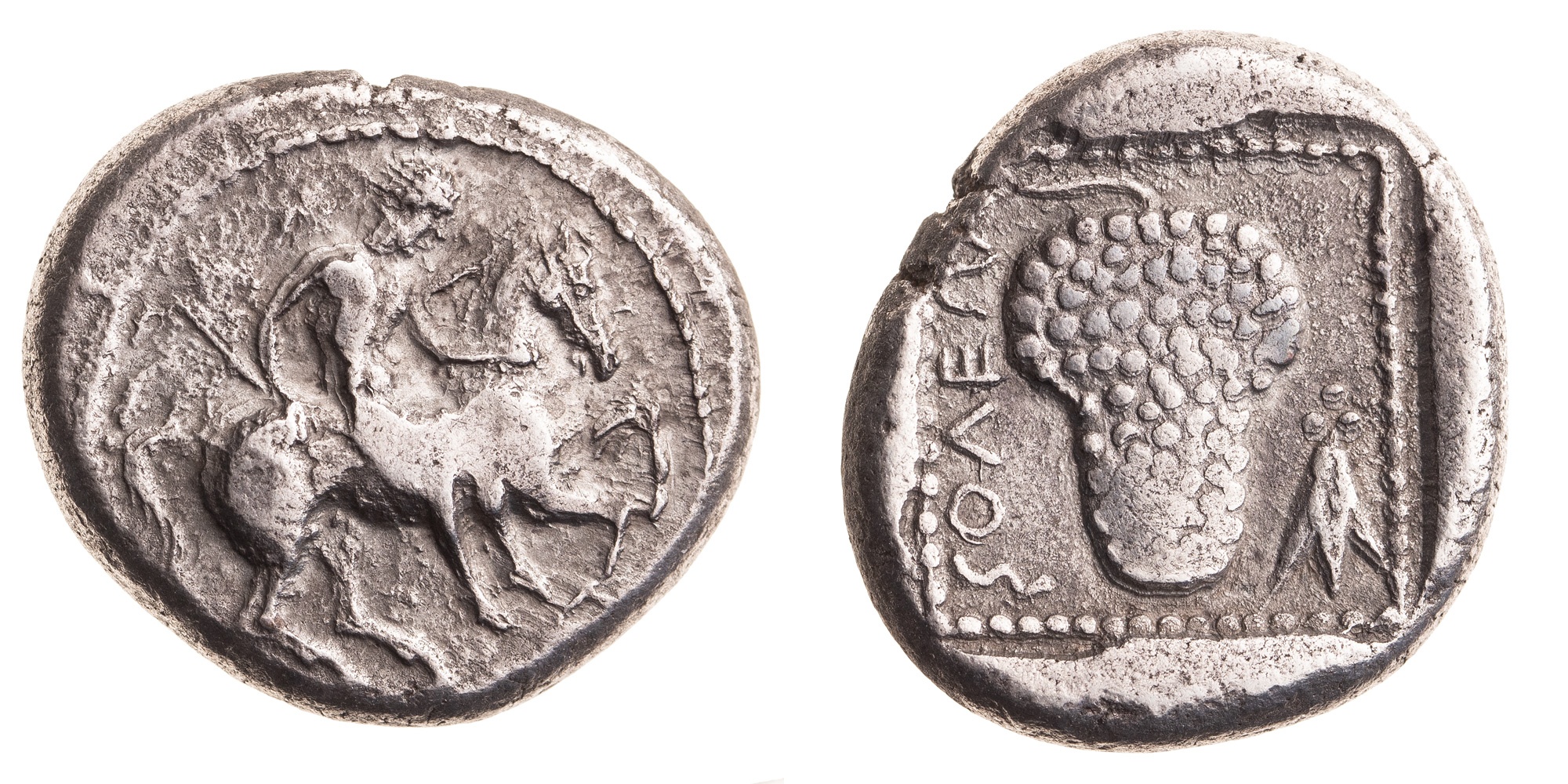
| Type HS.2 | |
| Denomination: | AR Stater |
| Obverse: | Youthful nude rider, holding reins in left hand and whip in right, dismounting from horse rearing to right; dotted border. | |
| Reverse: | Bunch of grapes; in left field, ΣΟΛΕΩΝ; in lower right field, fly; all enclosed by a dotted border within an incuse square. | |
| Metrics: | 10.50 g, 19–22 mm (the cited specimen) | |
| References: | Coll. P. Veselý, KES-AR-01 | |
| Credit: | P. Veselý (KES-AR-01) | |
| Remarks: | (1) | The obverse probably corresponds to that of Type 3.7a. The reverse corresponds to those of Soloi staters depicting a kneeling Amazon on the obverse (for a matching variant, see, for example, SNG Levante, 40, dated to 425–400 BC). |
| (2) | It is unclear whether this is a contemporary imitation or whether the official Kelenderis and Soloi dies were used. | |
Staters
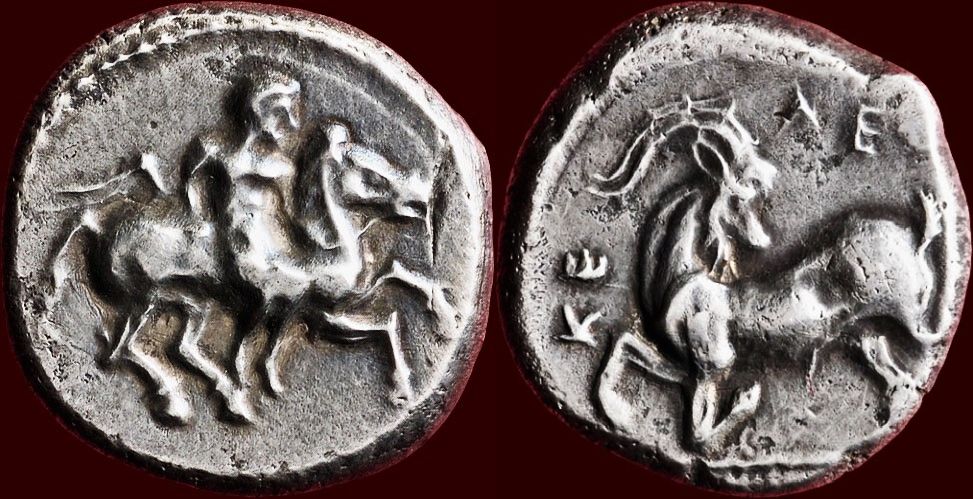
| Type XS.1 | |
| Denomination: | AR Stater |
| Obverse: | Youthful nude rider, holding reins in right hand and whip in left, dismounting from horse rearing to left on dotted (?) exergual line; solid (?) border. |
| Reverse: | Male goat kneeling to left, head turned back to right; below goat, banker’s mark; all within square (?) incuse. |
| Metrics: | 10.66 g, 22 mm (the cited specimen) |
| References: | Solidus Numismatik, Auction 138 (10 December 2024), Lot 1135 (acsearch.info URL) |
| Credit: | Solidus Numismatik (see the reference above; the original photo of the obverse was rotated 19° to the left to place the exergual line horizontally) |
| Remark: | This anepigraphic coin is probably an ancient imitation modelled on Type 2.1b. The following atypical elements of its design indicate an imitation: (1) the exergual line is incorrectly positioned relative to the horse so that the horse is tilted forward (the highest point of its rump is almost at the level of its ears) and the hooves of its hind legs are high above the exergual line; (2) the goat rests directly on the edge of the incuse. |
| Type XS.2 | |
| Denomination: | AR Stater |
| Obverse: | Youthful nude rider, holding reins in right hand and whip in left, dismounting from horse rearing to left on solid (?) exergual line; dotted border. |
| Reverse: | Male goat kneeling to left, head turned back to right; above goat, ivy branch; all within an incuse. |
| Metrics: | unknown weight, 22 mm, 12h (the cited specimen) |
| References: | Heritage Auctions, Inc., Auction 232447 (20 November 2024), Lot 63082 (acsearch.info URL) |
| Credit: | Heritage Auctions, Inc. (see the reference above) |
| Remark: | This anepigraphic coin is very likely an ancient imitation of the Kelenderis stater Type 2.6a. This is evidenced by the following atypical elements of its design: (1) the rider’s feet are high above the ground, higher than the level of the hoof of the horse’s nearer front leg (its left front leg); (2) the very long tail of the horse reaching almost to the level of its fetlocks; (3) the absence of the exergual line on the reverse; (4) the short horns of the goat. |
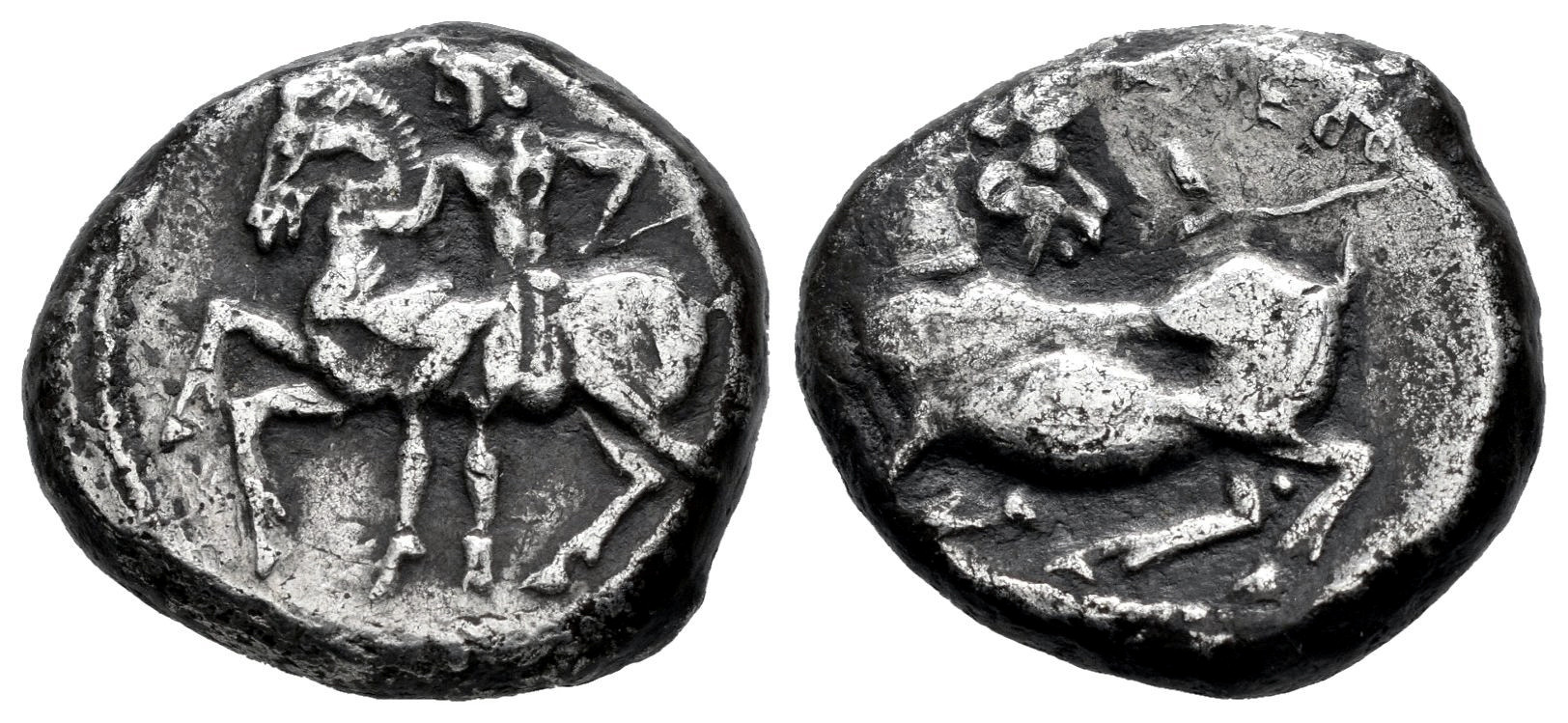
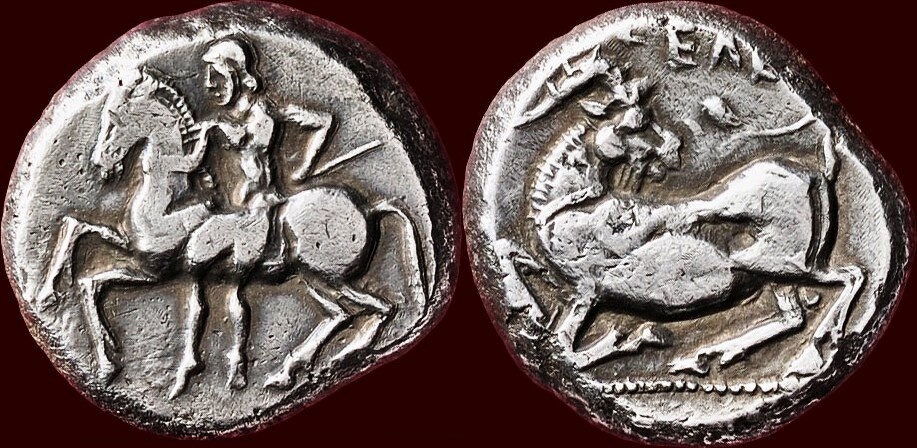
| Type XS.3 | |
| Denomination: | AR Stater |
| Obverse: | Youthful nude rider, holding reins in right hand and whip in left, dismounting from horse rearing to left; dotted border. | |
| Reverse: | Male goat kneeling to left on dotted exergual line, head turned back to right; above goat, KEΛE[N?]. | |
| Metrics: | 1: | 8.40 g (the cited specimen) |
| 2: | 9.16 g, 19 mm (the cited specimen) | |
| References: | 1: | Tauler & Fau Subastas, Auction 156 (21 April 2025), Lot 49 (acsearch.info URL). |
| 2: | Munthandel G. Henzen, Fixed Price List (accessed 22 May 2025). | |
| Credits (see the references above): | ||
| 1: | Tauler & Fau Subastas | |
| 2: | Munthandel G. Henzen | |
| Remark: | Both specimens were probably struck from the same obverse die. Their crude style suggests that they are contemporary imitations. They may have been modelled on Type 2.6a, although Types 2.8, 2.9c and 2.11a with the obverse letters omitted cannot be ruled out. | |
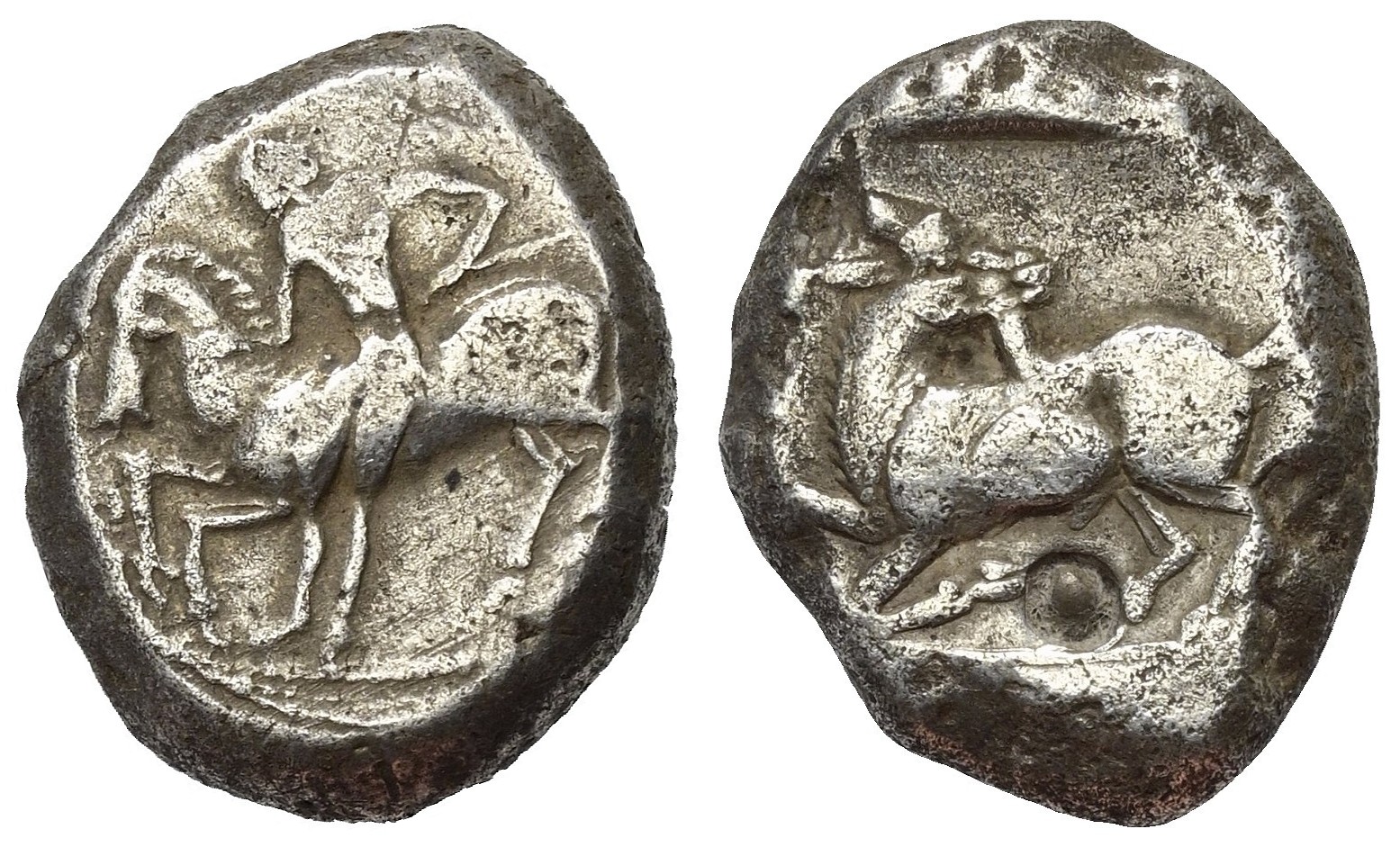
| Type XS.4 | |
| Denomination: | AR Stater |
| Obverse: | Youthful nude rider, holding reins in left hand and whip in right, dismounting from horse rearing to right on dotted exergual line. |
| Reverse: | Male goat kneeling to left, head turned back to right; all within circular incuse; above goat, KEΛ. |
| Metrics: | 9.59 g, 21 mm (the cited specimen) |
| References: | Naville Numismatics, Auction 98 (12 October 2025), Lot 790 (acsearch.info URL). Ex Gorny & Mosch Giessener Münzhandlung, Auction 196 (7 March 2011), Lot 1841 (acsearch.info URL). |
| Credit: | Naville Numismatics |
| Remark: | This is a contemporary imitation that shares its obverse die with Type HS.1 above. The observations made about the obverse of Type HS.1 therefore also apply here. On the reverse, the goat’s raised right leg is anatomically misplaced and the letters are carelessly executed. The model for this coin was probably Type 3.1a. |
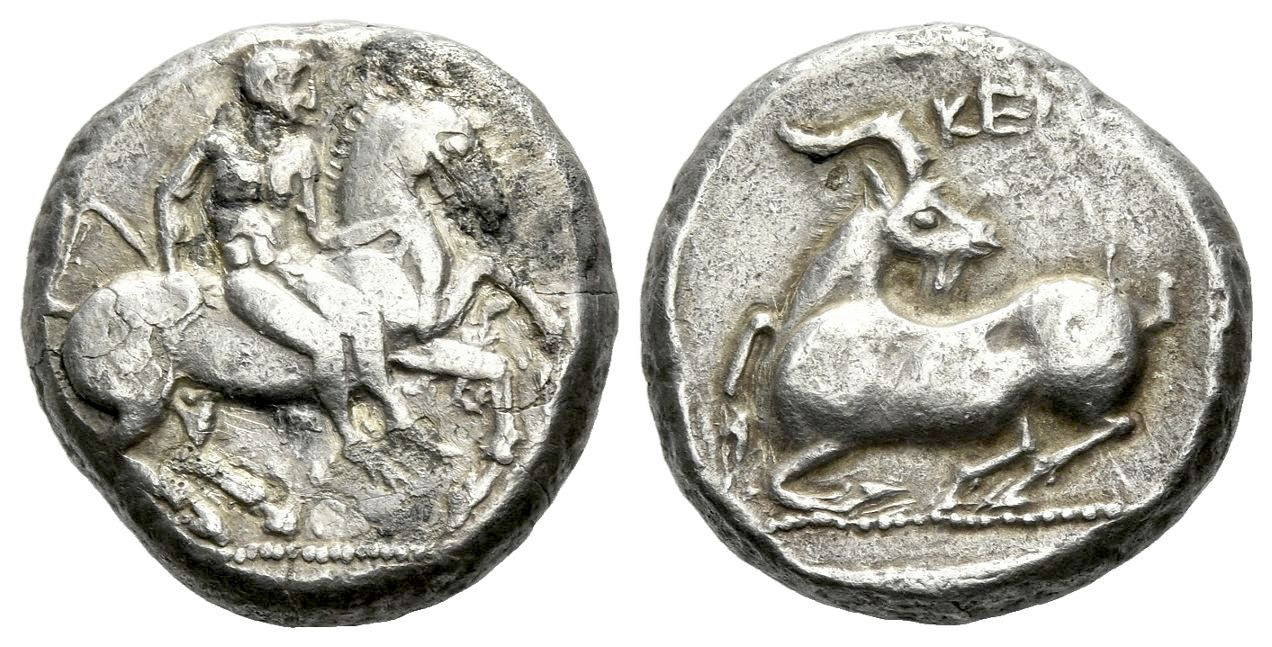
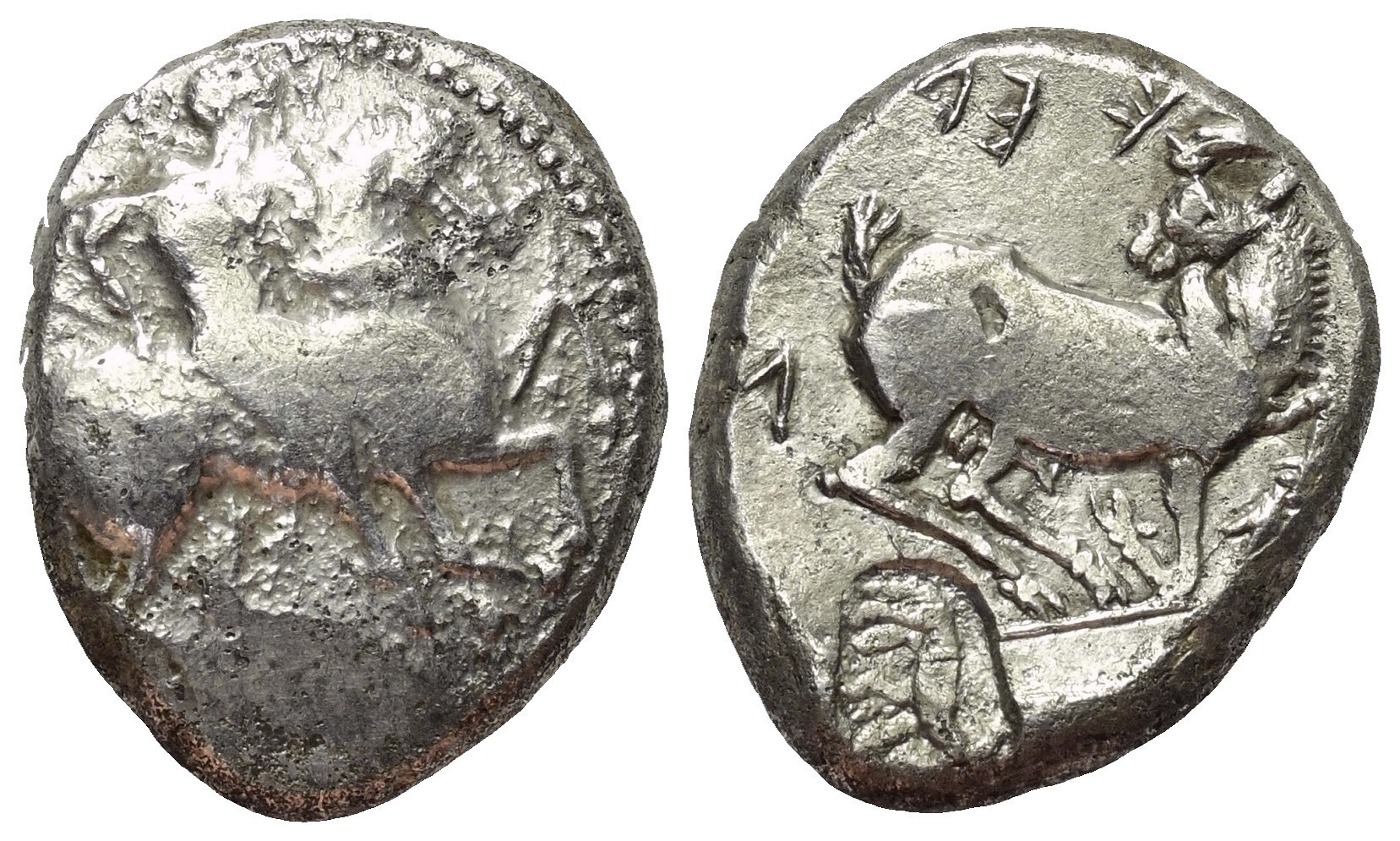
| Type XS.5 | |
| Denomination: | AR Stater |
| Obverse: | Youthful nude rider, holding reins in left hand and whip in right, dismounting from horse rearing to right; dotted border. |
| Reverse: | Male goat kneeling to left on exergual line, head turned back to right; before and above goat, KE–ΛE. |
| Metrics: | 10.28 g, 21 mm (the cited specimen) |
| References: | Munthandel G. Henzen, Fixed Price List (22 October 2023). |
| Credit: | Munthandel G. Henzen (see the reference above) |
| Remark: | This coin corresponds to Type 3.3, but is probably an ancient imitation for two reasons. First, the blurred details cannot be explained by a weak strike, so either the official dies were very worn or this coin was struck from poorly made unofficial dies. However, if the official dies were worn, this would mean that a large number of coins were struck from these official dies, but other coins from these dies are unknown. Second, although the obverse image is very blurred, its clumsy style is evident. In particular, the proportions of the horse’s neck relative to its head are unusual, the relative position of the horse’s hind legs is unrealistic, and the whip handle is too robust relative to the rider’s hand and at the same time its lower part ends high above the horse’s back (the worn die could have been coarsely retouched, but then the whip handle would extend to the rider’s palm). |
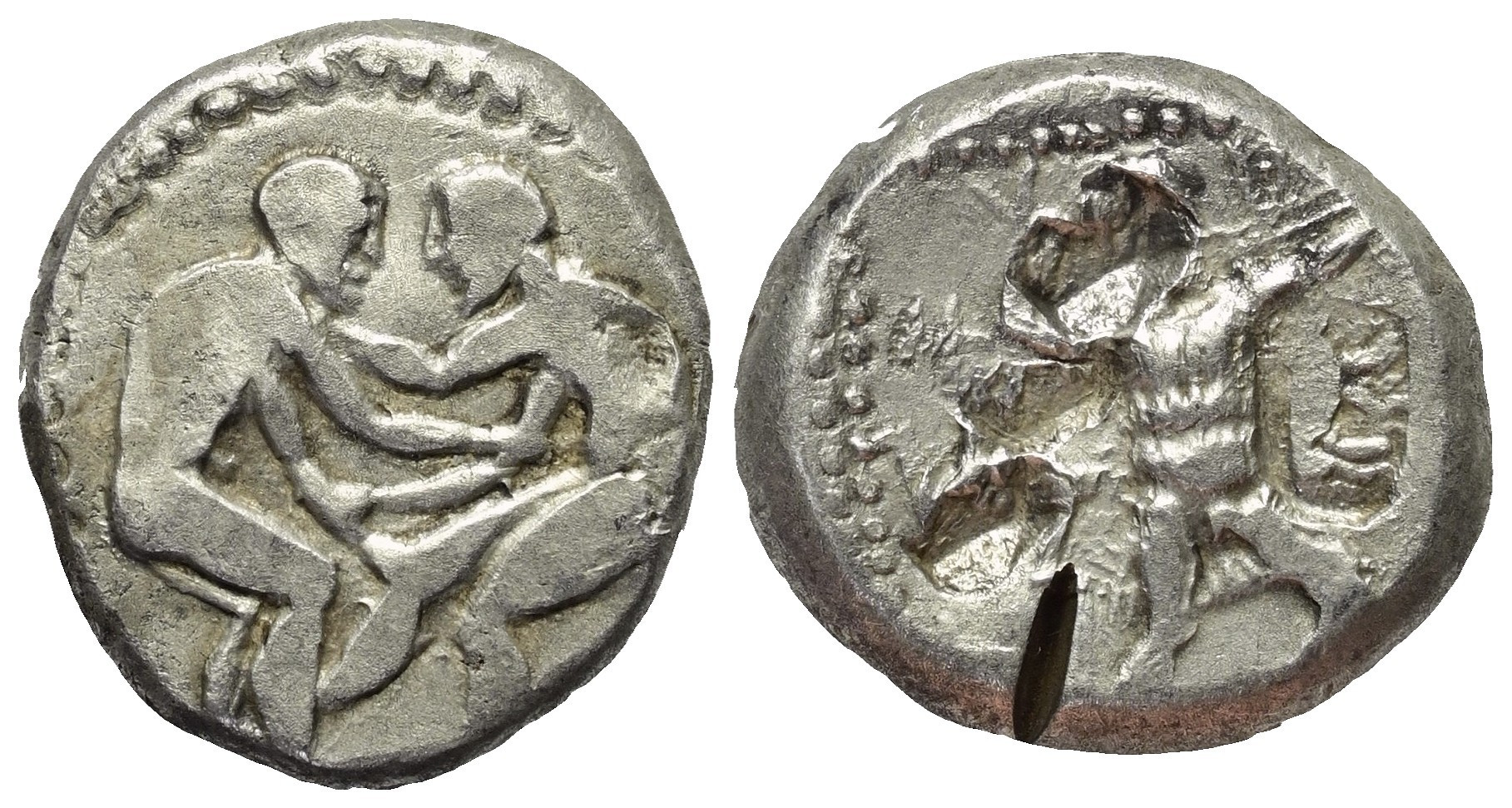
| Type XS.6 | |
| Denomination: | AR Stater |
| Obverse: | Youthful nude rider, holding reins in left hand and whip in right, dismounting from horse rearing to right; dotted border. |
| Reverse: | Male goat kneeling to right on solid exergual line, head turned back to left; above goat, KEΛ reversed and retrograde; in left field, Λ. |
| Metrics: | 10.73 g, 22 mm (the cited Kelenderis specimen) |
| References: | Solidus Numismatik, Auction 141 (18 March 2025), Lot 103 (acsearch.info URL) = Savoca Coins, 319th Weekly Blue Auction (18 April 2026), Lot 74 (acsearch.info URL). |
| Aspendos coin linked by countermark: Solidus Numismatik, Auction 141 (18 March 2025), Lot 81 (acsearch.info URL). | |
| Credit: | Solidus Numismatik |
| Remark: |
The reverse of this coin displays several striking oddities: strangely deformed and carelessly positioned letters; an isolated letter Λ to the left of the goat; anatomically inaccurate depictions of the goat’s hooves and the junction of its horns with its head; and a peculiar countermark depicting an animal with unusually powerful legs (a bull or a canine?). These oddities may indicate a modern forgery, although an ancient origin cannot be ruled out, for two reasons: 1. Hundreds of genuine Kelenderis coins are readily accessible online and in print, and a potential counterfeiter would presumably have used one as a model. Even if the model’s inscription were poorly or incompletely preserved and the counterfeiter did not know the Greek alphabet, they could at least have placed the letters in a row instead of distributing them so irregularly and rendering K and E so conspicuously and clumsily. 2. Unlike the reverse, the obverse displays no suspicious anomalies and resembles a coin struck from a heavily worn and corroded die. It would be strange for someone to go to the trouble of reproducing such an unattractive image. If, however, the obverse were copied from a genuine coin using modern technology, the counterfeiter could have used the same method for the reverse and thereby avoided the striking oddities noted above. Interestingly, the Aspendos stater shown above (10.67 g, 22 mm), which may belong to Tekin’s Series 2 (Tekin 1997), bears the same countermark. Given the identical countermark and the unusual style of both coins, either both are modern forgeries or both are ancient. In the latter case, their style would suggest that they are ancient counterfeits rather than imitations. The countermark could then have been applied by the ancient counterfeiter to create the impression that the coins had been validated by an official authority. This would, however, mean that the workshop produced imitations of issues from two different mints. Whether modern or ancient, the Kelenderis coin was probably modelled on one of Types 3.7, 3.8 and 3.9. |
Obols
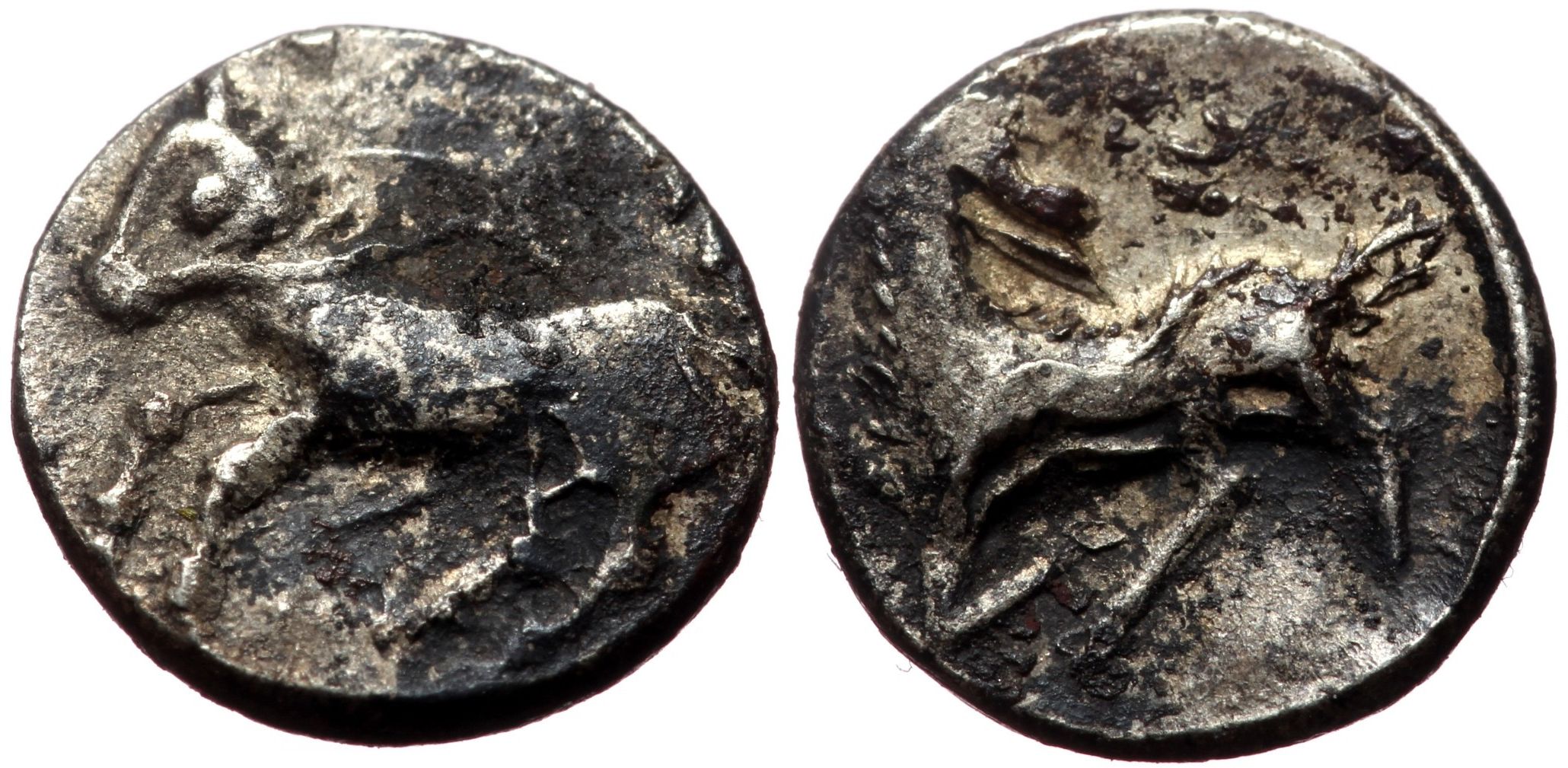
| Type XO.1 | |
| Denomination: | AR Obol (?) |
| Obverse: | Bridled horse with loose reins rearing to left; dotted border (?). | |
| Reverse: | Goat kneeling to left, head turned back to right; above goat, unclear letters (perhaps KE reversed and retrograde). | |
| Metrics: | 0.55 g; 0.49 g, 9 mm (the cited specimens) | |
| References: | SNG Levante, 30; Numismad.com Marcin Surgiewicz-Śliwiński, Auction 9 (8–9 September 2023), Lot 403 (biddr.com URL) | |
| Credit: | Numismad.com Marcin Surgiewicz-Śliwiński (see the reference above) | |
| Remarks: | (1) | This coin is of the same type as SNG Levante, 30 (see Type 5.11a) and may have been struck from the same reverse die, although the small photograph in SNG Levante makes this impossible to determine with certainty. Both specimens are characterised by low weights for the type: 0.55 g for SNG Levante, 30, and 0.49 g for this specimen, compared with a mean of 0.72 g and a standard deviation of 0.06 g for Type 5.11. The crude style of this coin and the anatomically unusual placement of the goat’s hind legs are atypical of Kelenderis. It is therefore probably a contemporary imitation. The SNG Levante specimen is nevertheless included in the main catalogue under Type 5.11a because its small photograph is insufficient to determine whether it too is an imitation. |
| (2) | The only other specimen of the SNG Levante, 30 type known to me is listed in the Classical Numismatic Group catalogue, Auction XXVI (11 June 1993), Lot 293. It is labelled there as a hemiobol, but its weight is not given and no photograph is included. | |
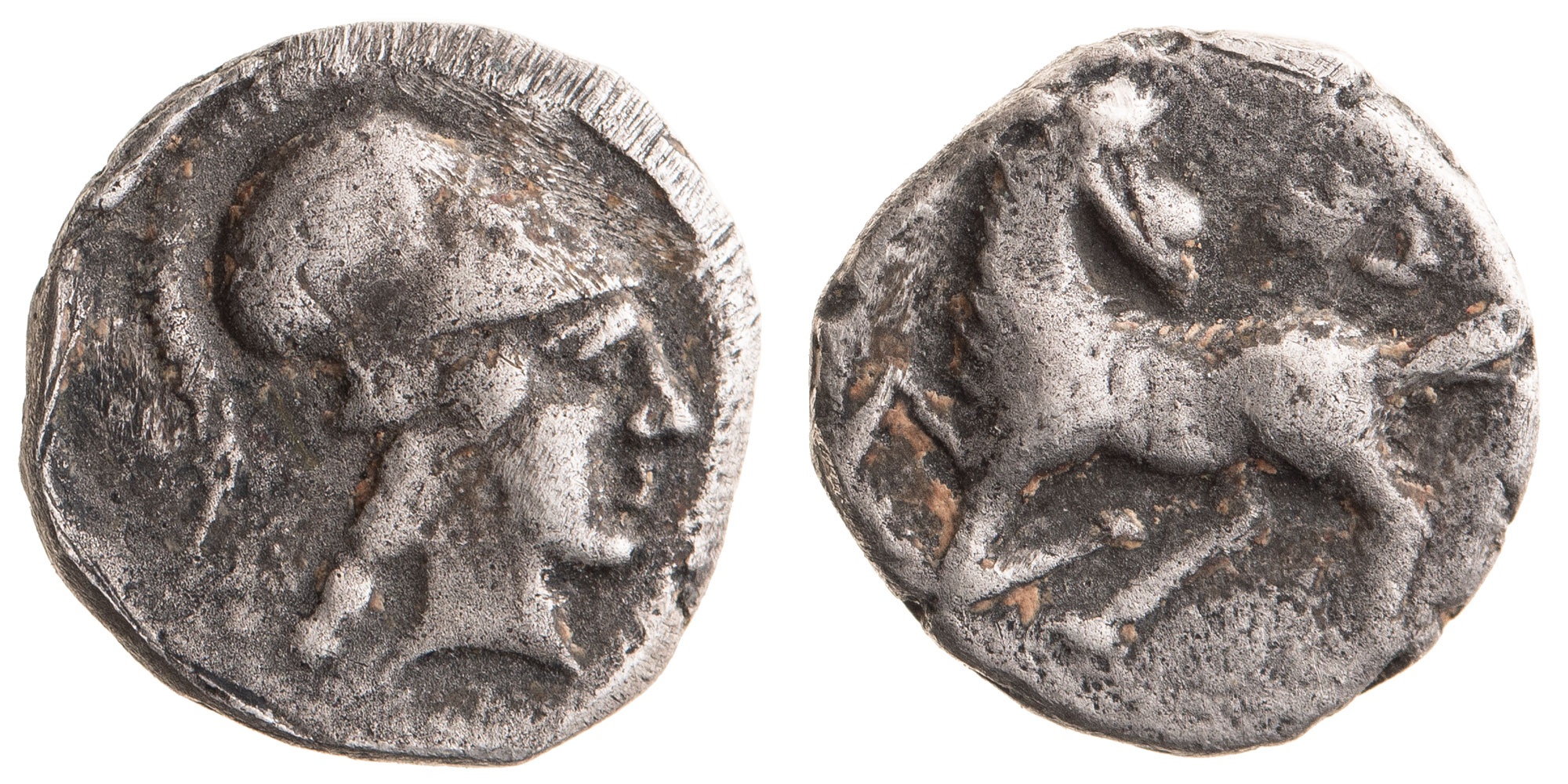
| Type XO.2 | |
| Denomination: | AR Obol |
| Obverse: | Head of Athena right, wearing a necklace and a Corinthian helmet; dotted border. |
| Reverse: | Male goat kneeling left, head turned back; above goat, ΚΕ reversed and retrograde (letter K uncertain). |
| Metrics: | 0.61 g, 8–9 mm (the cited specimen) |
| References: | Coll. P. Veselý, UNC-AR-03 |
| Credit: | P. Veselý (see the reference above) |
| Remark: | The design of this coin corresponds to Type 5.9b. However, the crude style and retrograde reverse legend show similarities to Type XO.1, suggesting that it is more likely a contemporary imitation. |
25 April 2023 – 30 August 2026